US Recession Fears Keep Dollar Pressurised, Aussie, Pound Climb
US Recession Fears Keep Dollar Pressurised, Aussie, Pound Climb Gold Extends Rally, Oil Steadies on OPEC Agreement, Stocks Slip

Summary: The Dollar finished mostly weaker against it’s rivals as the US markets returned in holiday-thinned trading yesterday. Sterling surged past one-month highs at 1.2500 (1.2450) against the overall weaker Greenback and on weekend news that UK PM Boris Johnson left the hospital, continuing his recovery from Covid-19. USD/JPY fell 0.56% to 107.75 (108.45) weighed by demand for safe-haven assets. News that the coronavirus outbreak may be nearing a peak in the United States was outweighed by an extremely uncertain outlook as global recession fears continued to dominate sentiment. Gold prices rose to their highest in over seven years to USD 1,713.50 (USD 1,684.00) pressurising the Dollar. The Easter Monday holiday in parts of Asia and through most of Europe saw extremely thin volumes. Commodity-linked currencies finished best performers in FX, with the Australian Dollar climbing 0.68% to 0.6390 (0.6345). The Euro was unable to benefit from the Dollar weakness, finishing modestly lower to 1.0910 (1.0935). Emerging Market Currencies were mostly weaker against the Greenback, presenting a mixed overall FX landscape. An agreement over the weekend by OPEC and Russia to cut oil production by 9.7 million barrels a day through May and June lifted Brent Crude Oil prices by a modest 1.08% to USD 33.50 (USD 33.00) in choppy trade. While the production cut was historic, it fell short of investor expectations for a 10 million barrels/day cut. Significantly reduced global demand for oil kept prices volatile. The Canadian Dollar still rose against its US counterpart, the USD/CAD pair slipped 0.43% to 1.3856 (1.3950), a 4-week low.
Wall Street stocks dipped at the close with the Earnings season due to start today. The DOW was 1.56% lower to 23,420 while the S&P 500 finished at 2,767 (2, 796) 1.09% lower. US Treasury yields rose. The benchmark 10-year US bond yield was up 5 basis points to 0.77%.
Data released on Friday saw US Headline CPI dip to -0.4% in March, lower than forecasts of -0.3%. Core CPI fell to -0.1% against expectations of +0.1%. Earlier in the day, China’s Annual CPI dipped to 4.3%, missing forecasts at 4.9%. Chinese PPI fell to -1.5%, lower than expectations of -1.1%.
On the Lookout: Traders will focus on the Covid-19 curve flattening in the US, Europe, the UK and Australasia and the prospects of a V-shaped economic recovery. Economic data will be closely scrutinised in the days/weeks ahead.
Today starts off with New Zealand’s REINZ House Price Index and February Visitor Arrival’s. Australia follows shortly with its National Australia Bank Business Confidence Index and Conditions for March. China’s March Trade Balance is today’s main report, both in CNY and USD terms with the breakdown in Exports and Imports. US Import Prices finish off today’s economic data reports. The week ahead sees US Headline and Core Retail Sales (Wednesday), the Bank of Canada Monetary Policy Meeting and Rate Statement (Thursday morning, early), Australia’s Employment report (Thursday) and the CNY trifecta of GDP, Fixed Asset Investment, and Industrial Production. China also reports its March Retail Sales (all on Friday).
Trading Perspective: FX kicks-off today with the coronavirus risk continuing to dominate. While the Dollar stayed mostly on the weak side with commodity-linked currencies like the Aussie, Kiwi and Loonie registering gains, Emerging Market currencies fell. The Euro failed to take advantage of the overall weaker Greenback while Sterling surged to one-month highs. The US Dollar was lower against the Japanese Yen, as demand for havens stayed strong. The uneven FX performance against the generally weaker US Dollar will see more mixed trading before any trend emerges.
We look at the FX market positioning tomorrow in a thin trading week.
AUD/USD – Battler Stays Bid, China Trade Data Next – 0.6425 Resists
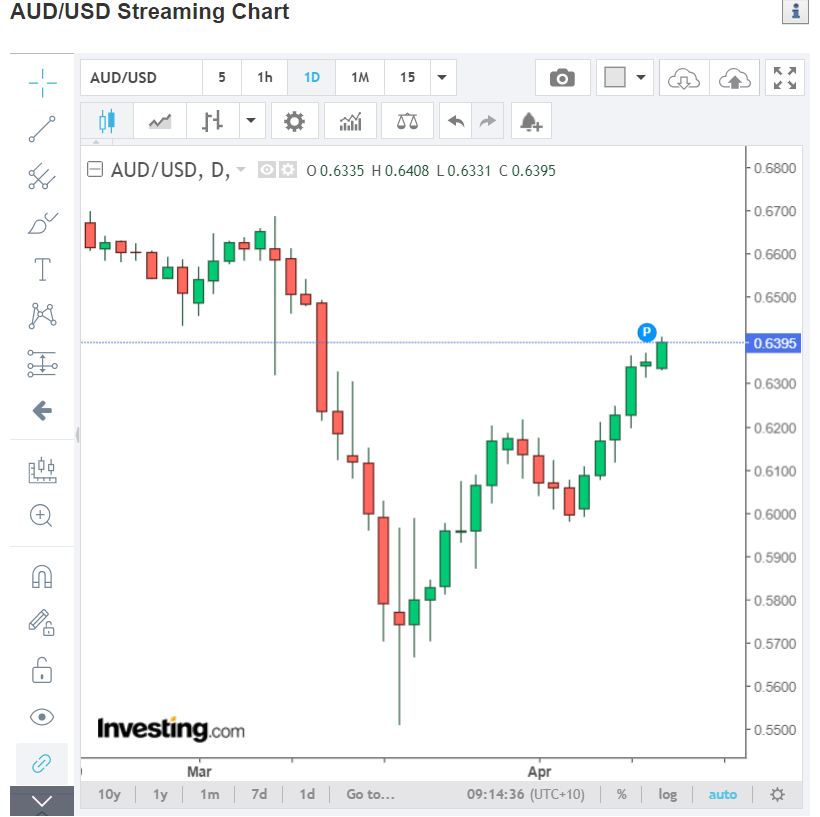
The Australian Dollar kept its bid against the overall weaker US Dollar and strong Gold prices despite weaker equities and Emerging Market currencies. AUD/USD opens at 0.6392 in early Sydney, up from Friday’s close at 0.6358. While the Aussie stayed bid, Emerging Market and Asian currencies were mostly weaker against the US Dollar. This will be a factor in the Battler’s attempt to gain further ground. Traders today will also focus on the data coming out of Australia and China.
Australia’s National Australia Bank March Business Confidence and Conditions Index kick off today’s economic reports. China follows with its Trade Data for March where economists are expecting a recovery. Median forecasts are for a trade surplus of +CNY 175 billion from February’s Deficit of -CNY 43 billion.
AUD/USD has immediate resistance at the 0.6425 level followed by 0.6475. Immediate support lies at 0.6350 and 0.6320. AUD/USD should see a trading range today between 0.6325-0.6425. Prefer to sell rallies today with the Asian currencies remaining weak.
USD/CAD – Lower on Strong Commodities, BOC Rate Meet Eyed – 1.3850-1.4150
The Loonie lifted against the broadly-based weaker US Dollar, stronger Gold prices and a tentative rebound in Brent Crude Oil prices. While the OPEC and Russia managed to agree a production cut of 9.7 million barrels a day, which is the deepest cut ever, it still fell short of investor’s expectations.
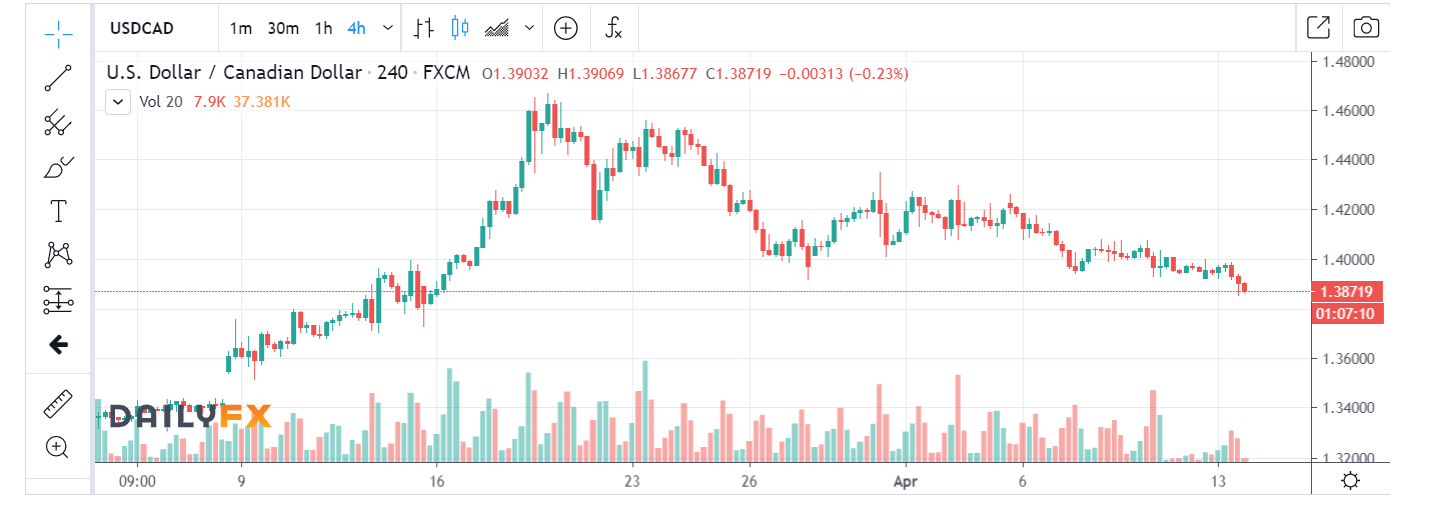
USD/CAD opens up in early Sydney at 1.3880 from its 1.3900 New York close. Overnight low traded was 1.38557, the weakest for USD/CAD in a month.
The week’s big event for the Canadian Dollar is the Bank of Canada’s rate policy meeting on Wednesday (early Thursday Sydney). Most economists are expecting the BOC to keep its Overnight Rate at 0.25%. FX Street’s economic calendar have left their forecasts of the Overnight rate blank which suggests there is the slight chance of a cut. Latest economic data out of Canada have disappointed and gives the BOC a slightly dovish bent.
USD/CAD has immediate support at 1.3850 followed by 1.3820 and 1.3790. Immediate resistance can be found at 1.3900 followed by 1.3950. With the Bank of Canada’s interest rate policy meeting this week expect a likely range of 1.3950-1.4150. Prefer to buy dips.
GBP/USD – Extends Advance on Weaker USD – 1.2550 Caps, 1.24 Base
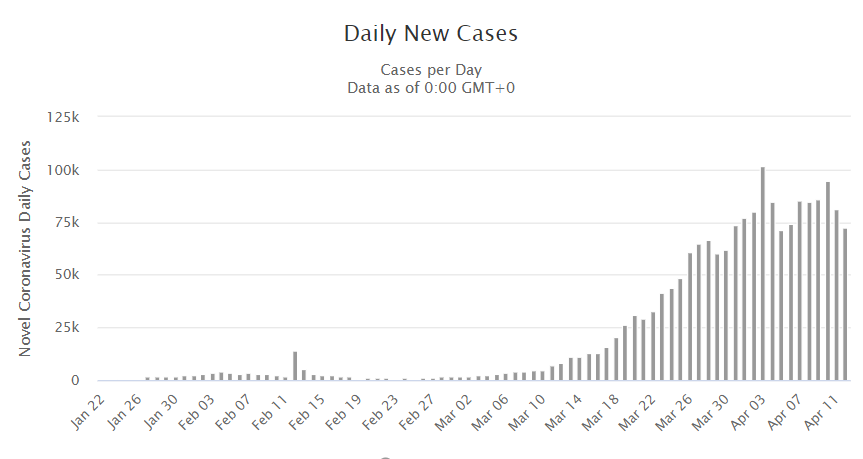
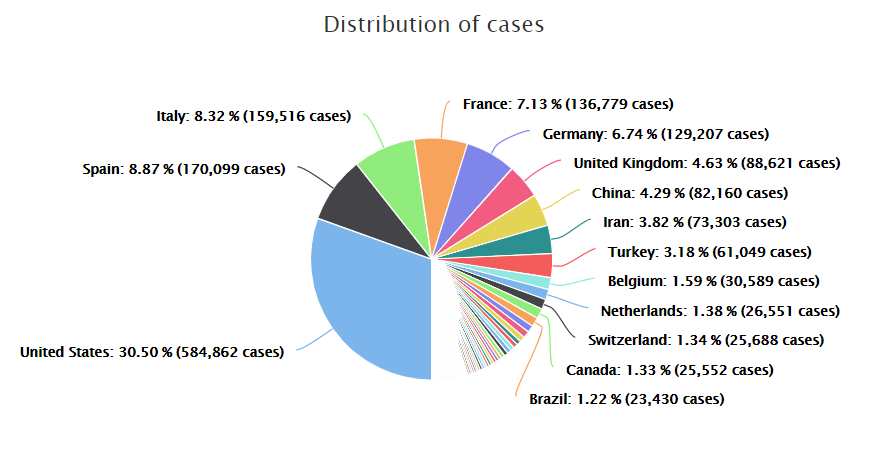
The British Pound extended its advance on the broad-based US Dollar lifting to 1.25369, fresh overnight and one-month highs. UK Prime Minister Boris Johnson, hospitalised in Intensive Care due to Covid-19, was released and continues his recovery. Total coronavirus cases in the UK (as at 13 April) reached 88,621 with deaths climbing above the 11,000 mark to 11,329. FX reaction was relatively muted in thin trading conditions.
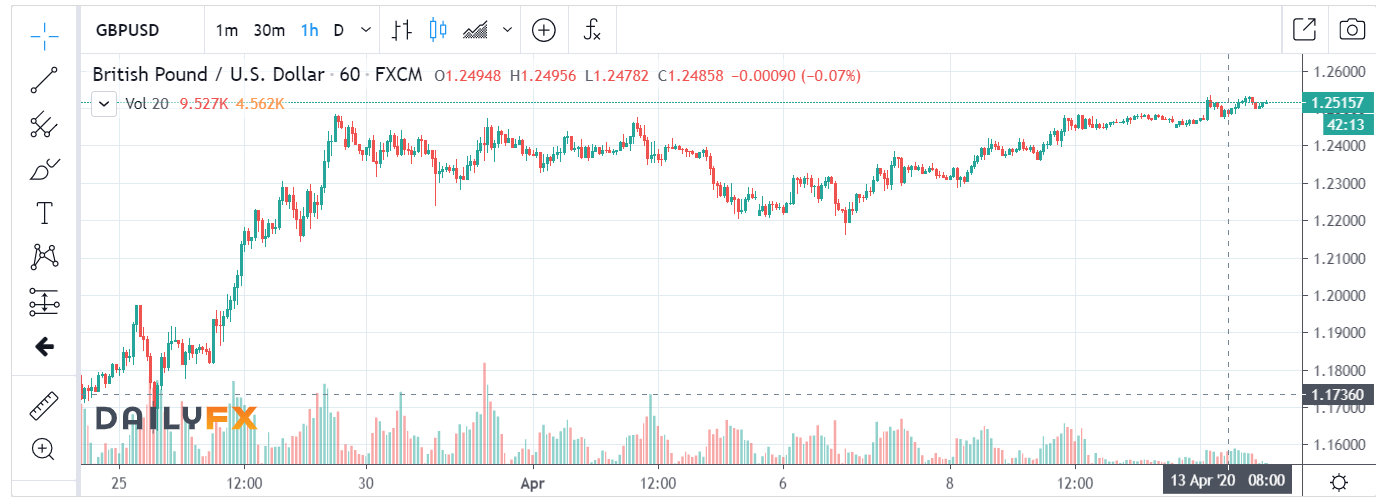
GBP/USD opens bid in early Asia at 1.2522 from its New York 1.2508 close and 1.2447 Friday. Immediate resistance can be found at 1.2550 followed by 1.2590 and 1.2620. Immediate support lies at 1.2450 followed by 1.2400. Sterling’s movements will be dominated by the US data and Dollar with no major data releases this week. Britain’s Covid-19 developments will also be monitored.
Look to sell into strength today with a likely range of 1.2430-1.2530
Reporting by Michael Moran. Filed 14 April 2020, 01:48 GMT.


